
The whole firm on one screen. Nobody compiles a report.
A multi-attorney firm used to run on a weekly spreadsheet someone had to build by hand. We replaced it with a live dashboard that pulls Clio data automatically: revenue, billable hours against goal, and collection rate, per attorney, in real time. Even the attorney roster keeps itself current.
The Problem
The numbers existed. Someone had to go get them.
The data was all in Clio: hours, invoices, payments, matters. But turning it into something an owner could act on meant a person exporting, pasting, and formatting a spreadsheet every week. The report was stale the day it was sent, it consumed staff time every single week, and the questions it could answer were limited to the columns someone had thought to build.
And every personnel change broke it quietly. A new associate would not show up in the numbers until someone remembered to add them.
What We Built
Spreadsheets to live truth.
Revenue and collections, live
Revenue and collections pulled from Clio automatically. The owner reads the current state of the firm, not last week's snapshot.
Billable hours against goal
Each attorney's billable hours tracked against their goal, in real time, so a slow month is visible while there is still time to do something about it.
Collection rate per attorney
Billing is only half the story. The dashboard shows what each attorney actually collects, which is the number the firm lives on.
A roster that maintains itself
The attorney roster syncs automatically from Clio. A new hire appears on the dashboard without anyone configuring them. A departure deactivates the same way.
The dashboard reads from Clio through governed API integrations. It does not guess, estimate, or fill gaps with generated numbers. If the data is not in Clio, it is not on the dashboard. That is the point.
The Same Idea, Other Firms
Visibility is a pattern, not a one-off.
These are separate builds at other law firms we work with, built on the same principle: the owner should see what is happening without asking anyone to compile it.
Call scoring
At another firm, every intake call is transcribed and scored against the firm's own criteria. The owner sees intake quality across the team without listening to a single recording.
Speed-to-lead text-back
At another firm, a missed or new CallRail call triggers an instant text back to the caller, so the lead hears from the firm before they dial the next one. The owner keeps a kill switch and can turn it off at any moment.
Billing follow-through
Monthly-fee automation and failed-autopay reporting, so recurring billing problems surface as a report to act on instead of a surprise at month end.
What It Means for the Firm
Decisions on today's numbers. Not last week's.
The owner opens the dashboard and sees the firm as it is right now. The weekly spreadsheet ritual is gone, and so is the staff time it consumed. When a new attorney joins, they show up in the numbers on their own. When the owner wants to know how the month is tracking or where collections are slipping, the answer is already on the screen.
Everything the dashboard shows traces back to the firm's own systems, and every automated action behind it is logged. That posture runs across everything on our platform, and the full detail is on our security page.
Two more tools that run on the same platform: Case-File Fact Extraction and Payment Plan Manager.
Inside the platform
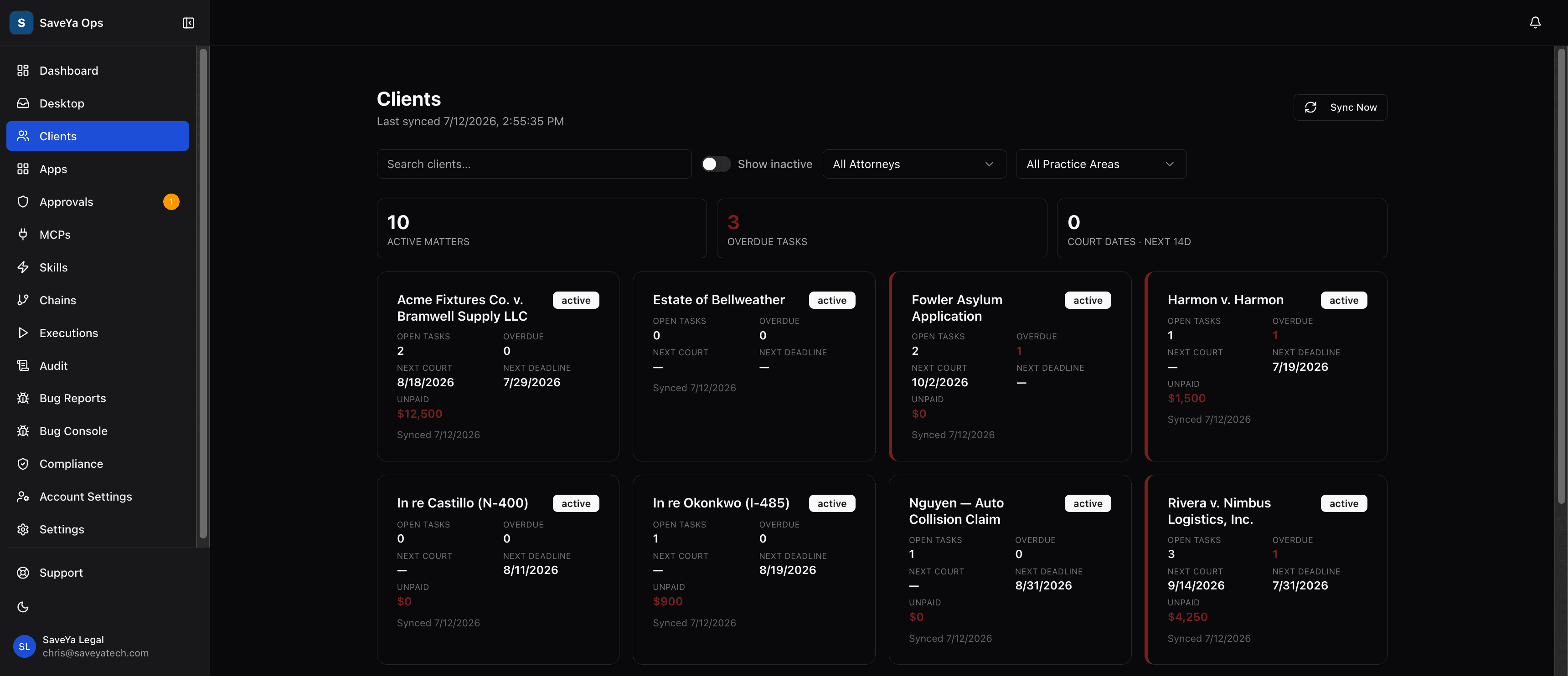
The whole caseload on one screen.
Every active matter with its open tasks, overdue flags, next court date, and unpaid balance, synced straight from the case system and filterable by attorney and practice area.
Nobody compiles it. It is current every time it opens, and it reads from the firm's own data, not a snapshot someone rebuilt by hand.
This screen is from a demonstration workspace with fictitious matters. No real client data appears anywhere.
Still running your firm on a spreadsheet?
Tell us what you wish you could see about your firm without asking for it. We will show you what a live dashboard on your own Clio data would look like.
Book a $250 ConsultThe consult: one hour with the team. You leave with a clear plan. Credited toward your build if you move forward.